Showing posts with label photographing art. Show all posts

Monday, October 4, 2010

New pastel portraits started, one from life, one from a photograph.

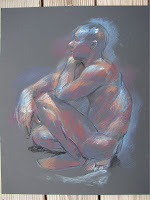
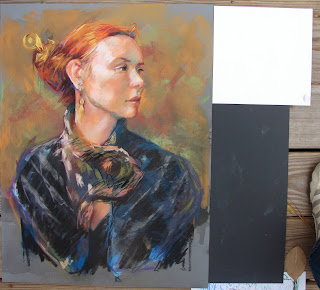
Over the past weekend I had two very different events and two different opportunities to start a pastel portrait.  Friday night, during the opening for Art of the Figure, we had a live model pose and I began a portrait in Nupastel on an olive green piece of Colourfix paper.  On Saturday, I participated in the Crabapple Festival in Milton, GA.  I used this opportunity, outside, a gorgeous sunny day, to set up my easel and start a portrait from a photograph of my little girl.  (This is not finished yet!)


I started out early in the day with just a few colors - some blues and fuscia - to define the large shapes. Then I started to add bits of warm and cool greens and pinks as well.


All during the festival visitors would stop and chat and we would discuss technique, what kind of photo to start from, how I chose my colors, etc.  I encourage people to select photos that are taken in natural light, that capture a casual moment rather than a forced smile.  When you are looking thru photos trying to decide what to turn into a portrait, look for the one that says to you "Now THAT is their personality!"


So what source of information is easier to work from - the live model or the photograph? One of the obvious benefits when dealing with a child's portrait is the photograph stays still.  However, when working from a live model, I tend to find a lot more color in and around the figure, as you can see here from Friday's live demonstration.


There is a lot of energy in the mark-making, and the layering of color is more "impulsive" rather than trying to match a photo.  However, since I did not get to finish that evening, I will resolve the features and finalize the piece from a photograph.

In the end, I think that portrait artists need a good balance of working from the live model and photographic references.  We can take the strengths of both an put them to use in our work.  If I end up with a reference photo that is a little monochromatic or too dark, I can remember the colors I find in the live model.

Thursday, March 12, 2009

Photographing a Dark Drawing, Getting a Better Value Range in Your Photograph

Drawings or paintings that have a narrow value range are often hard to photograph - ones that are overall grey can be almost impossible to capture all the subtle variations.

I just wanted to show you the best set-up for taking a photo of a piece like this drawing.

Give your camera a good value range to read - and try to put that range in the center of the camera (for my digital camera, I cannot press "half-way" and then MOVE the focus to take the picture - I have to just snap the picture.
So I need my value range right in the middle of the shot)

I did try with the value range set further apart - this was not as successful.

Taking photos of your art can be a big challenge - thankfully with digitial we have the freedom to explore and see the results instantly!

Click on the tag "photographing art" to see other examples.


Monday, November 17, 2008

Techniques - Taking Photos of your Art


Ok...I don't know if this is a lesson learned or forgotten and then re-learned, but I know a lot of my fellow artists need to take great photos of their work and I want to share a tip I discovered while taking photographs a couple of weeks ago.

I often have pictures/drawings that are pretty monochromatic - like the drawing of James on the black board. On the left is a photo I took of that drawing by itself.

And then on the right there is a photo I took with another picture next to it - a picture on a white background.

The colors and depth in James' drawing really improved because the camera was reading a broader value range.

I Incorporated this discovery into taking the picture of the pastel portrait - setting a piece of black and a piece of white mat board next to the drawing - and the value range of the portrait was much better.

I like to take my photos in bright but indirect sunlight - you can see my son lining up his art with mine to take pictures (he works right next to me in the studio...so of course his work needs to be photographed, too!)http://krystyna81.blogspot.com/2008/08/artistrya-hereditary-talent_04.html


I hope this helps for anyone taking pictures of 2D art...try to give your camera a full range of value to read, and your pictures will improve!